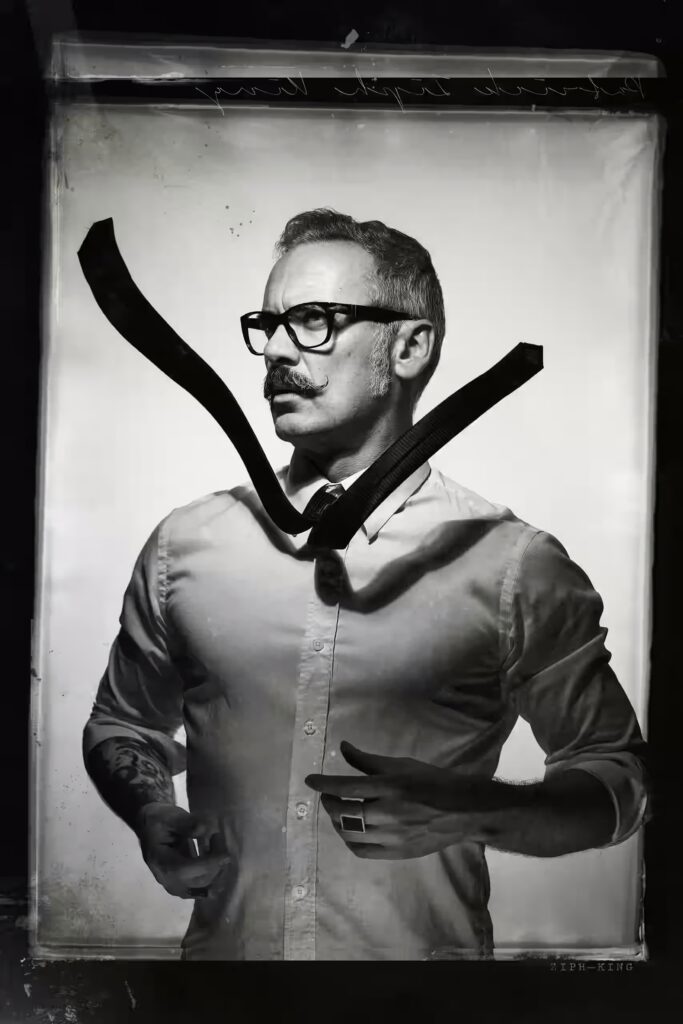
STRAJNIC (Patrick Strajnic), né en Suède, d’une mère française et d’un père serbe.
Si j’affinais, je dirais : né sur les rives du Cattégat, nourri au bord du Rhin, et affranchi face au Danube.
Je veux croire que c’est à la confluence de ces limons riches en mythes que je me suis fait artiste et boucanier.
Artiste pour qu’on remarque la moelle de mes os, et boucanier pour en orner mon drapeau d’encre noire.
Et c’est Élisée Reclus qui le dit le mieux : la géographie n’est autre chose que l’histoire dans l’espace, de même que l’histoire est la géographie dans le temps.
À la ligne, retournons le sablier.
Au début de ma vie d’artiste, j’étais photographe portraitiste. Pendant une douzaine d’années, j’ai sillonné l’Europe pour photographier des nymphes, des duchesses, des notables et des aventuriers.
Le portrait m’a longtemps fasciné : une alchimie de technique et de spéculation, où l’on cherche dans un visage ce qui déborde la personne elle-même.
Puis j’ai ressenti le besoin de raconter autre chose.
J’ai gardé mon boîtier mais j’ai déplacé son champ d’action.
La photographie n’était plus nécessairement l’endroit où l’image s’arrêtait. Elle pouvait devenir le commencement d’autre chose.
J’ai laissé entrer l’encre, le graphite, le fusain, l’eau, les pigments. Pour voir ce qu’elle pouvait encore devenir.
Il y a là une part de hasard, de mémoire, de lecture et d’interprétation. Quelque chose qui était déjà dans l’image, peut-être, mais que je ne voyais pas encore. Quelque chose aussi qui n’y était pas et qui trouve pourtant le moyen d’y prendre forme.
C’est ainsi que sont nés mes récits limoneux.
Limoneux, parce que le limon raconte le temps sur toutes les berges du monde, sans distinction. Mais aussi parce qu’il circule : il vient d’ailleurs, transporte avec lui des fragments d’autres temps, se mélange, se dépose, puis peut être remis en mouvement.
Je ne cherche plus tellement à savoir où finit la photographie et où commence le dessin, l’encre ou le fusain. Les médiums se passent le relais sans que je cherche à y ordonner une hiérarchie.
Le singulier peut y devenir le dépôt provisoire du commun, et le commun revenir s’y resserrer dans une forme singulière.
C’est un passage. Celui du limon.
Et c’est un retour, finalement, car jadis j’ambitionnais de devenir peintre sur l’une des berges citées plus haut. Et il est aussi vrai qu’on ne revient jamais tout à fait au même endroit.
Expositions:
- 2024: Moïra / salon d’art contemporain St’ART
- 2024: Azul / galerie Decorde
- 2023: Lucrèce / galerie Decorde
- 2022: Sisyphe / galerie Decorde
- 2022: Sisyphe / salon d’art contemporain St’ART
- 2022: Mon Faune / fondation Fernet-Branca
- 2021: Mon Faune / salon d’art contemporain St’ART
- 2021: Mon Faune / galerie Decorde
STRAJNIC (Patrick Strajnic), born in Sweden to a French mother and a Serbian father.
If I were to be more precise, I would say: born on the shores of the Kattegat, raised along the Rhine, and set free facing the Danube.
I like to believe that it was at the confluence of these silts, rich in myths, that I became both artist and buccaneer.
An artist, so that the marrow of my bones might be noticed; a buccaneer, so I could adorn my black-ink flag with it.
And Élisée Reclus put it best: geography is nothing other than history in space, just as history is geography in time.
At the line, let us turn the hourglass over.
At the beginning of my life as an artist, I was a portrait photographer. For some twelve years, I travelled across Europe photographing nymphs, duchesses, dignitaries and adventurers.
Portraiture fascinated me for a long time: an alchemy of technique and speculation, in which one searches a face for whatever spills beyond the person themselves.
Then I felt the need to tell something else.
I kept my camera, but shifted the field in which it could act.
Photography was no longer necessarily the place where the image came to an end. It could become the beginning of something else.
I let ink, graphite, charcoal, water and pigments in. To see what else it might become.
There is a part of chance, memory, reading and interpretation in it. Something that may already have been there in the image, but that I could not yet see. And something else that was not there at all, yet somehow finds a way to take shape within it.
That is how my silty narratives came into being.
Silty, because silt tells the story of time on every shore in the world, without distinction. But also because it travels: it comes from elsewhere, carries fragments of other times with it, mingles, settles, and can then be set in motion once again.
I am no longer so concerned with knowing where photography ends and drawing, ink or charcoal begins. The mediums pass the baton to one another without my seeking to impose any hierarchy upon them.
The singular can become the provisional deposit of the common, and the common can in turn gather itself back into a singular form.
It is a passage.
The passage of silt.
And ultimately, it is a return. Long ago, I dreamed of becoming a painter on one of the shores mentioned above.
And it is equally true that one never quite returns to the same place.
Exhibitions:
- 2024: Moïra / salon d’art contemporain St’ART
- 2024: Azul / galerie Decorde
- 2023: Lucrèce / galerie Decorde
- 2022: Sisyphe / galerie Decorde
- 2022: Sisyphe / salon d’art contemporain St’ART
- 2022: Mon Faune / fondation Fernet-Branca
- 2021: Mon Faune / salon d’art contemporain St’ART
- 2021: Mon Faune / galerie Decorde